
The School for Little Ones
Play, magic, exploration, experimentation, colour, garden, friends, autonomy, discovery, movement, connection, imagination, creativity.
Paichnidagogeio Little School is a place where children are heard — even when they don’t speak. Here, the child at play is at the centre. Children discover themselves and the world through relationships with others in an environment where they can express themselves in countless ways as part of a dynamic learning process.

At our school, children from 20 months to 6 years old join small groups: Magic Feet (2–3 years), Little Explorers (3–4 years), Travellers (4–5 years, pre-kindergarten), and Discoverers (5–6 years, kindergarten). Each group has 18–21 children and often divides into smaller subgroups during the day.
The Group
At every age, each child’s interests and abilities are combined with those of the other children in a small group. Activities are planned according to developmental stages and aligned with each child’s individual characteristics.
Holistic Development
Every day we encourage children’s development through movement and physical growth, social interaction, thinking and logic, and emotional understanding. Activities are designed around children’s developmental stages and needs.
The Parents
They are partners in our pedagogy and participate in their child’s development. They are informed, active, and productive members of the pedagogical team through the interaction of educator–parent–child–environment.
The Educators
Educators observe, listen, and create meaningful stimuli that inspire action and discovery. They encourage exploration, independence, and joy in learning.
The Environment
It stimulates the senses and serves as a source of inspiration. The space is designed to strengthen children’s natural curiosity and invite them to discover the world. It is full of materials that allow improvisation and expression.
Nature
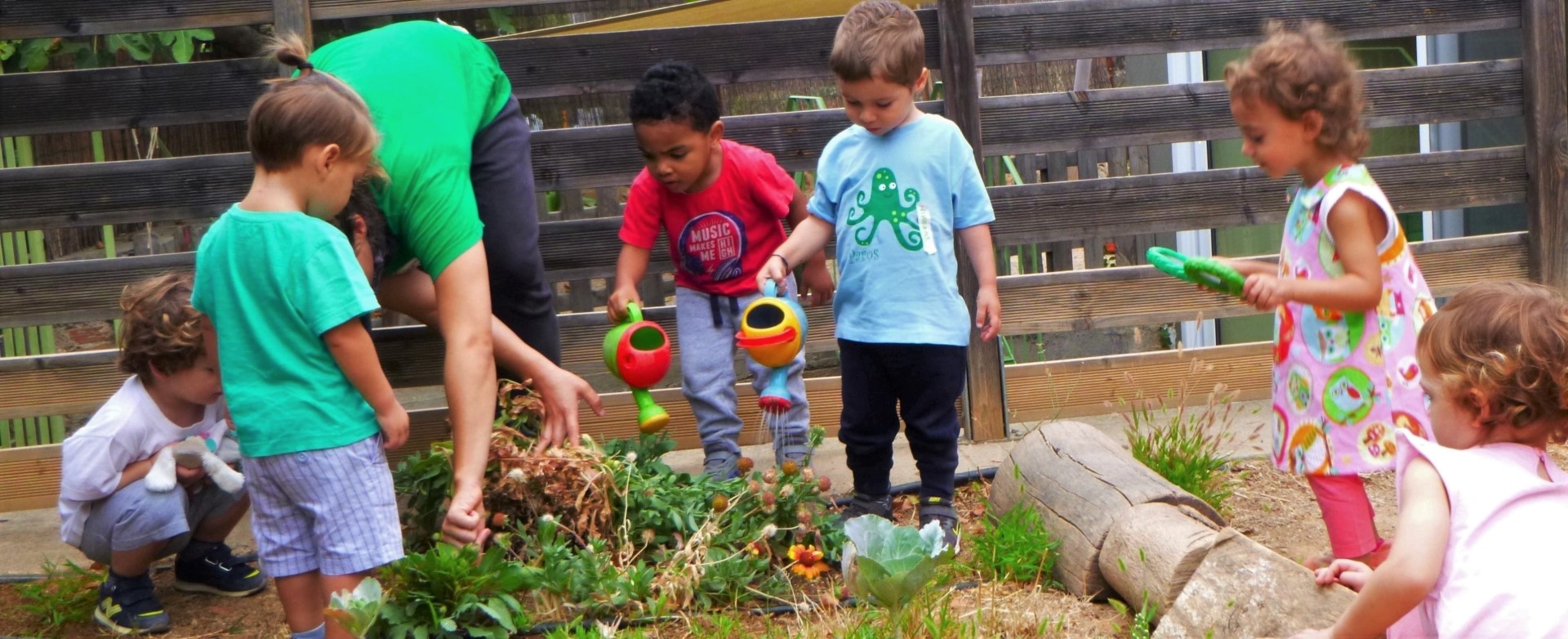
It appears both inside and outside the classroom, creating safe conditions for exploration—in the Atelier, the garden, nearby parks, the forest, or small wooded areas. Children have the opportunity to learn while developing skills in nature.
Play
As a process, it is both our method and our tool in all activities. Through play, children are invited to explore and push their boundaries, to be innovative in their creations, to resist conventionality, to make mistakes, and to invent solutions safely.
Well-Being and Learning Support Team
Each child and family is supported by our Psychopedagogical Team, which includes a speech therapist, paediatrician, nutritionist, psychologist, and educators specializing in learning differences.
Connection with the community
Throughout the year we organize workshops for parents, community events, and family celebrations, where the school connects with the neighbourhood and broader society through shared experiences.

A Glimpse Into Our Daily Life
Playing indoors and outdoors, throughout each day we aim for every child, and all children as a group, to grow through:
- Autonomy and a sense of safety
- Exploration inside and outside the classroom
- Companionship, friendships, and enjoyment
- Physical expression and music with a specialised educator
- Collaboration with educational goals in very small groups
- Valuable early writing and first mathematical concepts
- Collaboration with a speech therapist through group activities within the day
- Forming and managing relationships
- Experimentation in a safe environment
- Exposure to art and different artistic techniques
- Familiarity with nature and its creatures
- Connection with the environment they live in, through small excursions and encounters
- Familiarity with English
- In our programme, children, educators, and parents together shape activities: through “play,” which means the right to try, through “research,” which play transforms into a sense of discovery and through the development of the relationships between them.


Goals
We want every child to:
- To come to school feeling happy.
- To feel “at home” here.
- To discover themselves through interaction with others.
- To build their first relationships.
- To find ways of communicating that suit them, with words or without. To learn to love inquiry, experimentation, and learning through play.
- To try, explore, and wonder about the things that occupy their mind.
- To be exposed to rich stimuli that help them cultivate many aspects of themselves and recognise interests, inclinations, and talents.
- To develop strategies for managing difficulties.
- To fill up with knowledge, rather than mere information, through lived experience.
- To place what they learn into context as they grow, using more formal learning tools such as books or notebooks.
- To enjoy play as a process.

Frequently Asked Questions
The Early Childhood Centre operates from 08:00 to 16:00, from early September until mid-July.
The Kindergarten operates from 08:00 to 16:00, with the option of creative-play workshops from 16:00 to 17:00.
The official school year is set by the Ministry of Education: 11 September – 15 June. There is also the option to join the summer programme until mid-July.
8:00–9:00 – Arrival time. Play (unstructured, free-choice) indoors or outdoors
9:00–10:00 – Play (unstructured, free-choice) indoors or outdoors
10:00–10:20 – Circle time: morning hugs, greetings, group interaction. Children identify themselves as members of the group, including the educators
10:20–10:40 – Snack
10:45–12:00 – Autonomy routines, garden play
12:00–13:00 or until 13:30 depending on age: structured cognitive-development activities / play corners / interest-based stations (visual arts, cooking, imaginative play, movement play, puzzles, books, and many more arising daily from the children’s interests)
13:00–13:40 – Lunch and autonomy routines (for ages 2–4)
13:45–… – Nap or first departure period
15:40–16:00 – Waking up or preparation for departures, autonomy routines
We have chosen to remain a small, family-style school with one class (one group of children) per level. The children who make up the “Magic Feet” group (ages 2–3) each year are essentially the group that continues through to Kindergarten.
This means that unfortunately, we do not have places for all families who would like to join Paichnidagogeio.
However, each year, for any places that become available, we contact interested families in the order of their first communication with us.
For more information, you can contact welcome@paixnidagogeio.gr or 6980001266.
For the Magic Feet (2-3) and the Psachouleftakia (3-4), annual tuition is €6500 and covers the September–July operating period.
For the Taxideftakia (4-5) and the Exerevnitakia (5-6), annual tuition is €6500 and covers the full-day programme during the Ministry-defined school year.
Paichnidagogeio provides the morning snack. For lunch, families may either bring food from home or choose the Dadstronomy service, which delivers fresh, warm meals daily.
Menu planning and the overall nutrition framework are developed jointly by Paichnidagogeio and Dadstronomy, in collaboration with the NGO “Mathaino Diatrofi” (https://mathainodiatrofi.org/).
Paichnidagogeio’s school buses serve the following areas: Papagou, Cholargos, Agia Paraskevi, Chalandri, Filothei, Palaio Psychiko, Neo Psychiko, Girokomeio, Lycabettus, Kypseli.